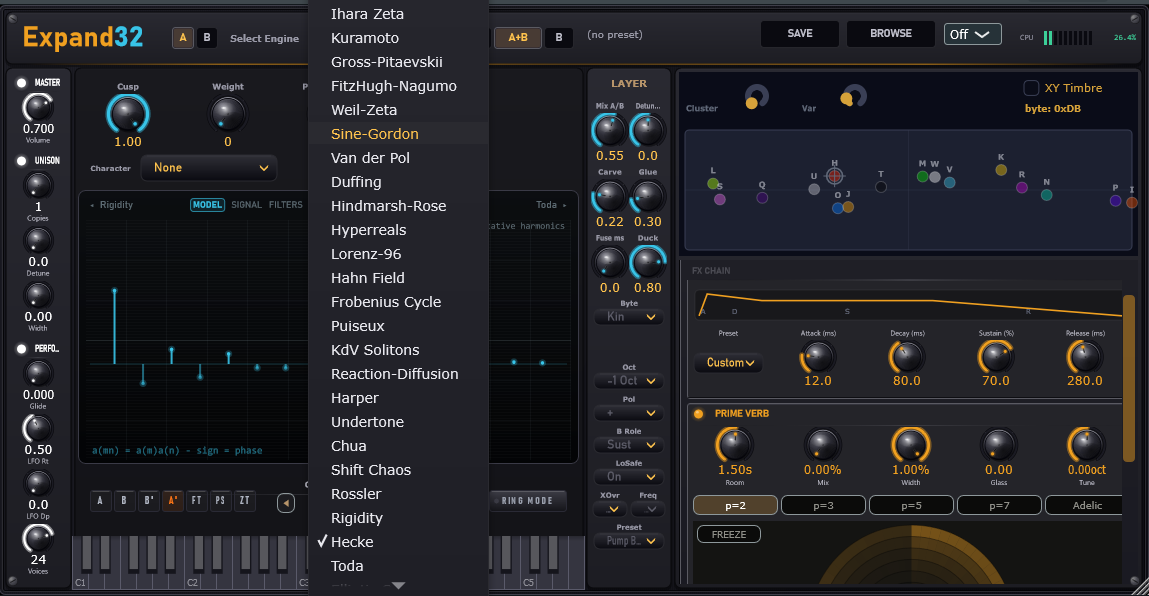
Unifying the 70 engines showed that they were never 70 separate ideas — they are one instrument seen from seventy angles, and that shared foundation finally needed a name. It isn't wavetable, additive, FM or physical modelling; it doesn't behave like any of them, so we gave it one of its own. Completing that unification moves Expand32 Synth to late August 2026.
The three FX — Tree FDN · Prime Verb · Prime Lineage — are available today, and they are built on that same substrate. Right now they are the shortest way to hear where the instrument comes from.
Every beautiful mathematical structure can be heard.
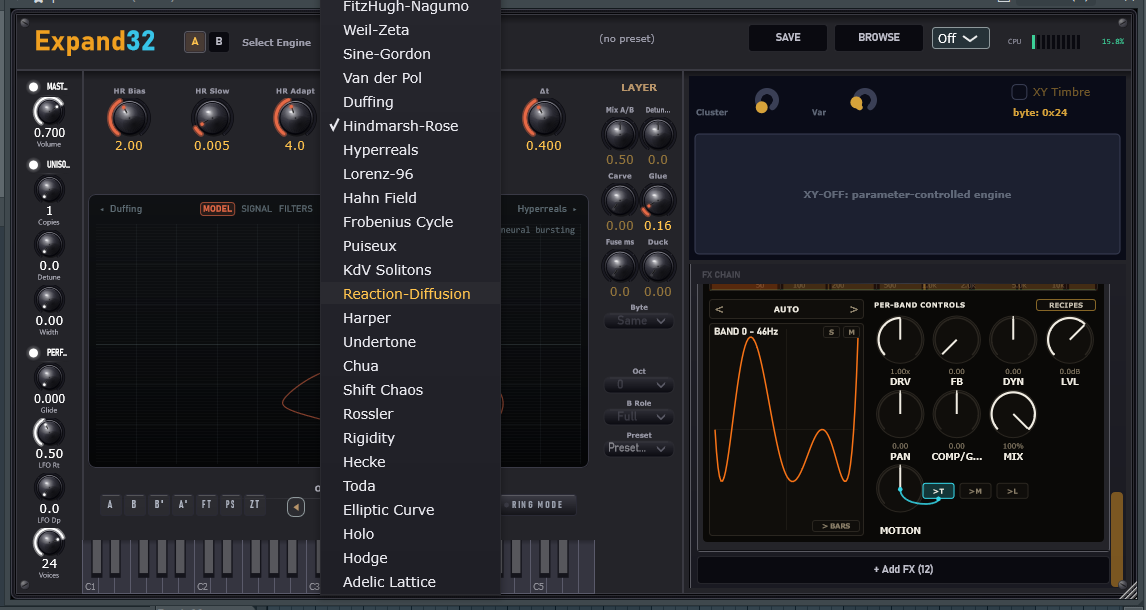
Most synthesizers give you one method — wavetables, FM, granular — and a thousand presets. Expand32 gives you seventy methods: each engine is a different mathematical construction turned into a sound generator, from vibrating strings on exotic geometries to chaotic attractors, Galois fields and quantum wave packets.
They all speak one language — a timbre navigator of clusters and variants you can sweep live from an XY pad. Nearby positions sound nearby; timbre morphs along the same geometry that organizes melody. And 200 factory presets map the territory before you even start exploring.
Ultrametric operators, adelic products, integrable lattices — the real objects from the literature, not naming flair.

Instruments that emerged naturally from the system's substrate.
{{ f.body }}
The research doesn't stop.
Expand32 comes out of an active research program — more instruments and effects built on the same mathematics are already in development. Every purchase funds that work directly, and we give back in kind.
Promises scaled to reality: what support makes possible, we ship. What we ship, you keep.
New factory banks pushed to every owner as free updates.
As support grows, new engines land inside Expand32 itself as updates — not as paid add-ons.
Unique features reserved for first-version owners. Early trust, rewarded — for keeps.
Don't take our word for it.
Download the free demo — the three FX (Tree FDN, Prime Verb, Prime Lineage), 7 days, full sound quality. One installer for demo and full: a license key unlocks everything, even offline.
↓ Download free demoEach engine is a theorem you can play.
{{ fam.desc }}
+ latent "bridge" parameters: many engines expose the hidden knobs already inside their own equations.
Born from the substrate.
Live captures from the Eigen Scope — the actual internal state of each engine, not an animation.
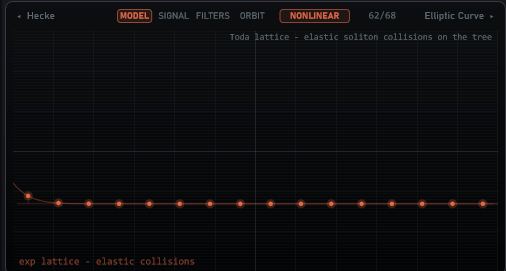
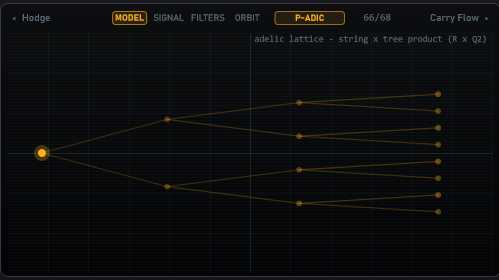
Descriptions kept general on purpose — the constructions behind these engines are ours. Researchers: it's probably doing exactly what you suspect. Write us.
Two engines, one instrument.
Most synths stack a second oscillator of the same engine. LAYER A+B runs two completely different mathematical engines at once, per note, and fuses them into a single voice — not two tracks glued by hand, one new timbre.
The fusion happens by construction, not by luck: both engines share the same envelope, pitch, glide, modulation and space — sources that start together and move together read as one. On top, a per-voice Glue stage saturates the A+B sum, adding the shared harmonics that lock the layers into a single perceived source.
Automatic complementary EQ, calculated from the engines' real spectra: it finds where A and B collide and carves each one the space the other needs. What an engineer does by ear, done by the math.
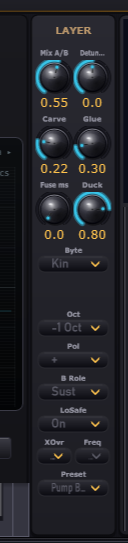
Layer related timbres: Same for maximum coherence, Kin for a close genealogical relative — "genealogical detune" — Anti for maximum contrast, Free for independence.
Slide B's onset from 0 to 50 ms and walk the perceptual line: one sound → fat attack → ornament → deliberate double-hit. Psychoacoustics as a knob.
Also in the panel: Mix · Detune · Octave · Polarity · Audition [A | A+B | B] · Focus lens · Duck (internal A→B sidechain) · B Role (Full / Transient / Sustain) · LoSafe & Crossover, so "B owns the sub" holds on every note.
— Plus 15 blend recipes that set the professional relationship between the layers in one click: Sub Anchor, Attack Top, Haas Wide, 808 Guard and more.
{{ f.body }}
Expand32 — Included for free for a limited time with the purchase of the bundle.

One selector chooses the arithmetic of the tail.
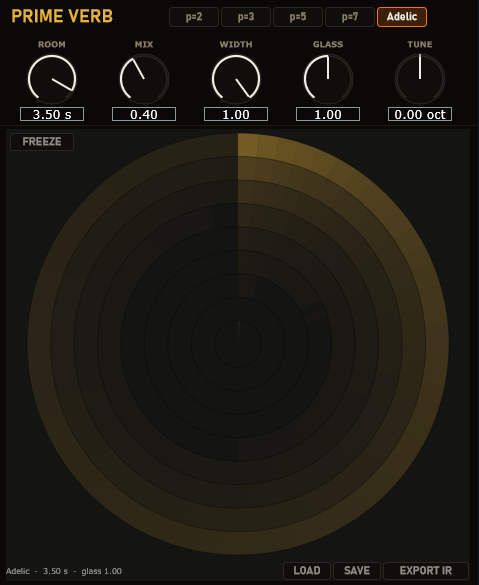
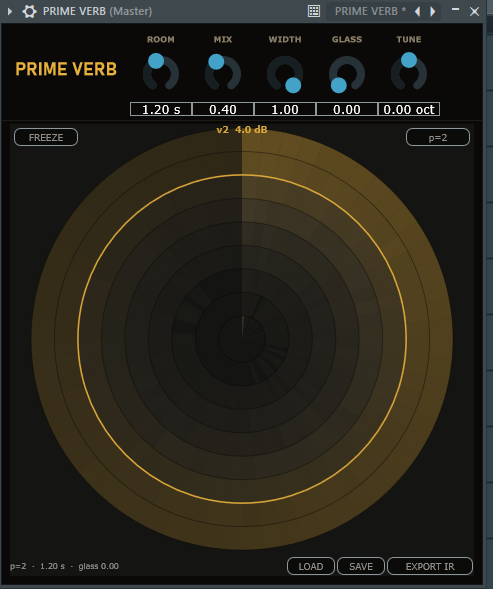
Every reverb on the market competes on uniform density. Prime Verb arranges its reflections in a self-similar hierarchy set by a prime — and the PRIME selector lets you choose which. From the dense binary genealogy to the Adelic tail — every prime at once — a family of spaces with an arithmetic character you won't mistake for anything else.
{{ fam.desc }}
The sunburst is the impulse response.
The radial tree isn't a picture of the reverb — it is the impulse response, ring by ring. Each ring is a generation of the tree; brightness is the real amplitude. Drag a ring and you lift or cut that whole generation at once — a Genealogy EQ over tree-time, a gesture no ordinary reverb could offer.
Outer rings are the young, dense reflections; the centre is the ancestral, sparse tail. The layout is the arithmetic, not decoration.

Measured, not marketed.
Every figure below comes from measurement on the shipping DSP — the same standard we hold Tree FDN to.
{{ f.body }}
Five knobs, the arithmetic, and the tree.
{{ c.desc }}
Eight rooms, measured distinct.
Prime Verb — Included in the bundle
The photograph and the living room.
A convolution of a number-theoretic impulse response: the space, captured exactly. Every reflection fixed in place — a room you can trust to never move.
A recursive network on the same tree — a room that breathes. Morph it while audio runs, watch the matrix rewire itself, and freeze it forever. This page.
Two different engines on one geometry — deliberately separate products, not two modes of one plugin.
Measured, not marketed.
Every figure below comes from measurement on the shipping DSP — the same standard we hold Prime Saturator to.
{{ f.body }}
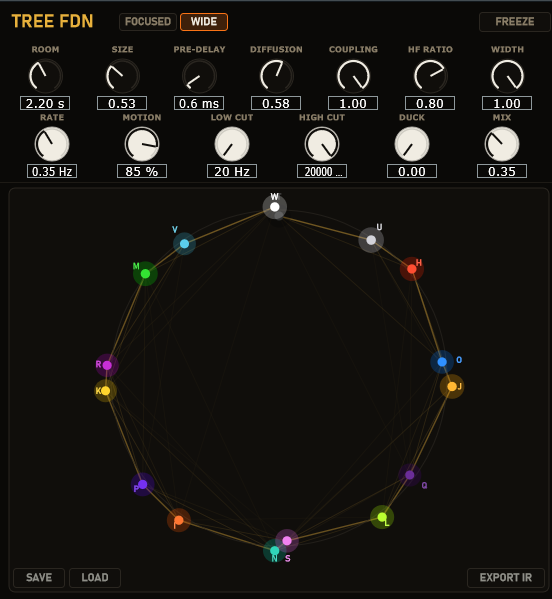
The graph is the reverb. Every chord is a live coefficient.
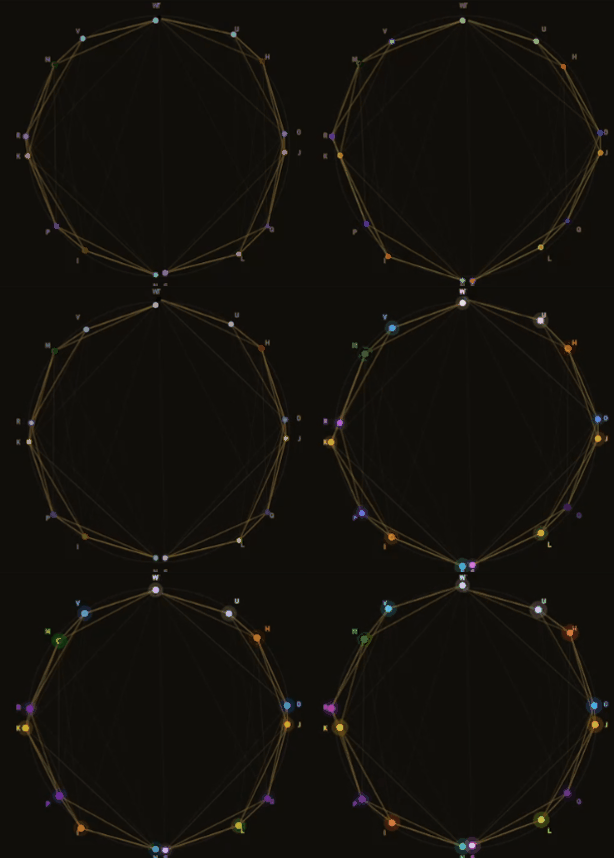
The circular graph isn't an animation of the reverb — it is the reverb. The chords draw the real mixing matrix, so turning Diffusion or Coupling visibly rewires the room. Each node glows with the actual RMS of its delay line, and breathes with the movement of that same line — every node on its own drift, none of them in step. Take Motion to zero and the graph goes still, because the engine has.
Every node sits where the structure of the tree puts it — the layout is the mathematics, not decoration.
Thirteen controls. The tree does the rest.
{{ c.desc }}
Plus FREEZE: gains to 1, exact conservation — the room holds forever until you let go, and the movement holds with it.
Damping lives in the structure: deeper nodes of the tree are darker, so the highs decay first, like a real room. HF RATIO scales that behaviour instead of stacking a filter on top of it.
COUPLING was called DEPTH until this release. Saved projects and host automation are unaffected — only the label changed.
Twenty rooms, measured distinct.
Four families in the LOAD menu — Rooms & Plates, Halls & Chambers, Tree Signature, where the arithmetic is the point, and Cinematic & FX for the long tails. Every one sets all thirteen knobs, SIZE included, so a preset lands as the room it was measured as. And no two of them are the same room: every pair is measurably apart in decay, density, brightness or stereo width — none of them differs by length alone.
Tree FDN — Included in the bundle

One selector, from the DAW grid to echoes that never exactly repeat.
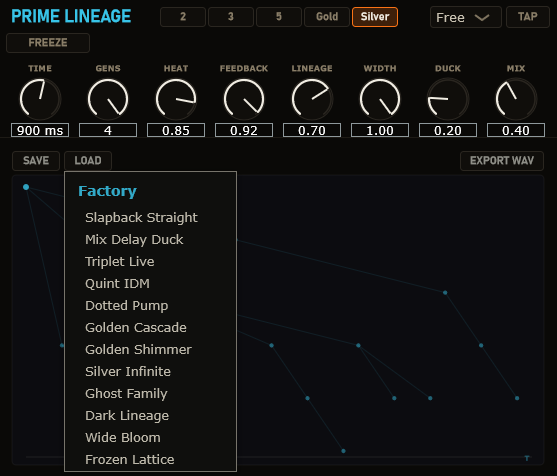
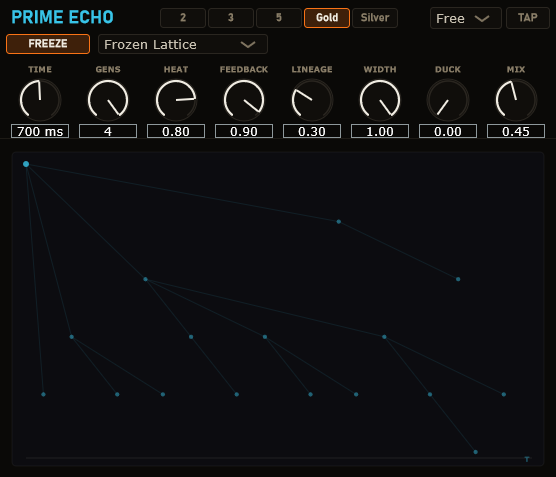
Five pills. 2 / 3 / 5 nail the grid — straight, triplet, quintuplet, sample-accurate (error ≤ 0.5 samples). Gold / Silver grow the taps from golden- and silver-ratio kinship: echoes that keep a quasi-periodic groove but never exactly repeat — and never stack into a comb. No other delay on the market has this axis.
{{ fam.desc }}
By generation, not by tap.
{{ f.body }}
Everything else.
{{ f.body }}
Classic multi-tap delays emulate vintage machines, modulate the line, or hand you a grid to draw taps on. None of them generate the pattern from a mathematical structure, and none have a single axis running from host-sync to non-repeating. "Golden ratio delay" exists as a manual recipe on forums — here it's a pill.
Every figure on this page — the ≤ 0.5-sample grid error, the ×17 smoother tails, the −0.7 dB mono fold — comes from measurement on the shipping DSP.
Prime Lineage — Included in the bundle
Try the FX free — or get everything.
The three FX are available now for demo and purchase. The 7-day FX demo uses the same installers as the full versions — your license key simply unlocks them.
Expand32 Synth releases late August 2026 — no demo until release.
No account inside the plugin — ever.

{{ lp.body }}
Questions, answered.
{{ q.a }}
Something else? Reach the team below — we answer everything.
Talk to the team that wrote the code.
Expand32 Sounds is built and supported by a small team — questions about licensing, the demo, or the math behind the sound go straight to the source.
Mathematical instruments for sound designers and producers. Pure real-time audio DSP — no telemetry, no tracking. One-time online license activation, then offline forever.